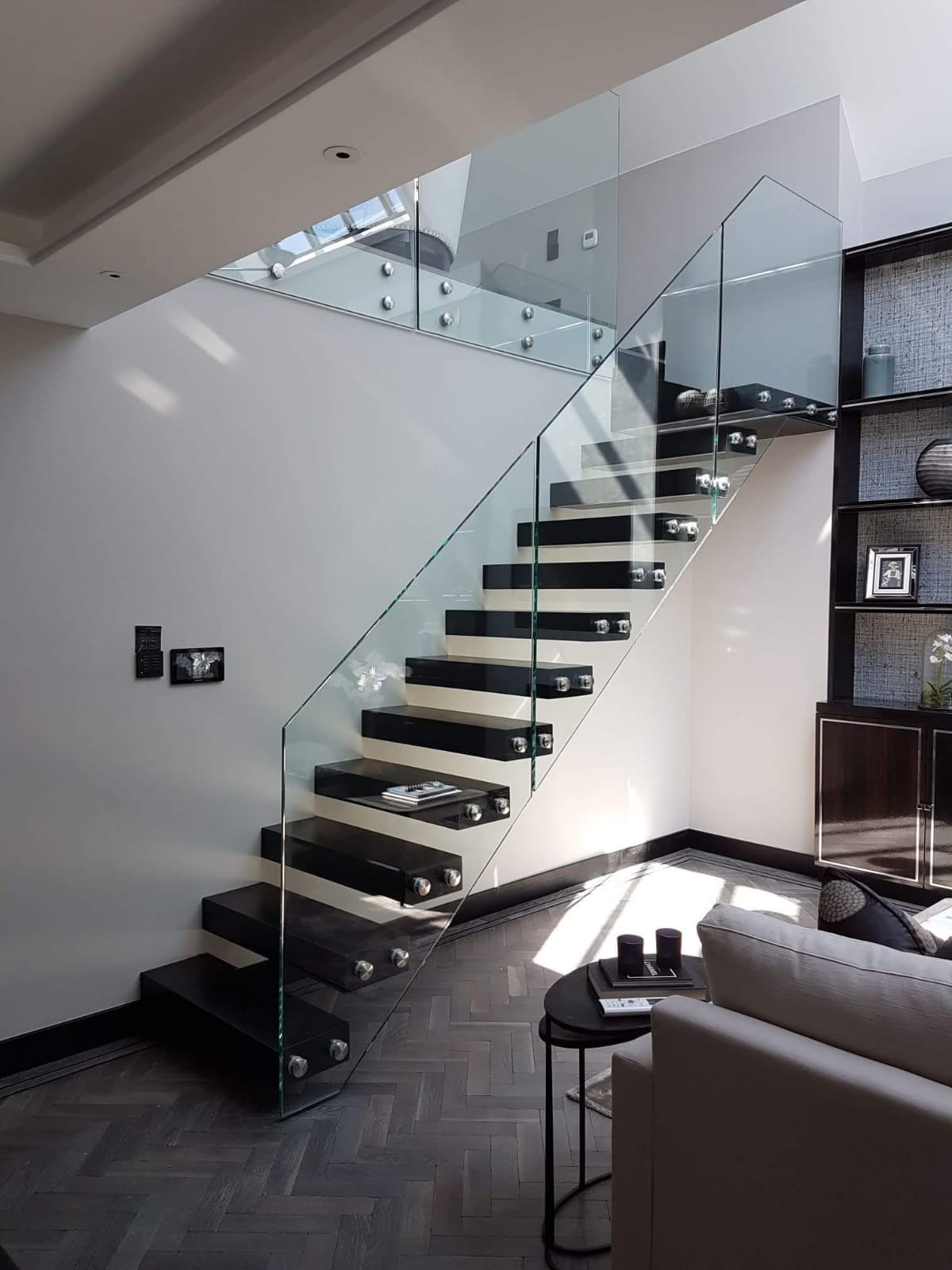
Safety glass is not an upgrade you choose. In some positions it is the only glass allowed. The rules sit in the Building Regulations, and the phrase to know is critical location: a place where somebody can walk into the glass, fall against it or put a hand through it. Glass in one of those positions has to either hold together when it breaks or break into pieces that do not cut.
Here is where that applies, written the way the guidance actually reads rather than the way a salesperson describes it.
1. Glass in a door, anywhere below 1500mm
Any glazing in a door with a part below 1500mm from floor level is a critical location. In practice that is nearly every glazed door in the country, because a door is around two metres tall and the glass in it starts well below shoulder height. It covers the small vision panel in a fire door as much as a fully glazed one.
2. The panel beside a door, within 300mm of its edge
A side panel within 300mm of either edge of a door is treated as though it were the door itself, up to that same 1500mm. That strip is where a hand goes when somebody misses the handle, and where a pushchair goes when the door is being held open. Outside the 300mm strip the same panel is judged as ordinary wall glazing instead, which is a lower zone.
3. Wall and window glazing below 800mm
Away from doors, the zone drops to 800mm from finished floor level. Any internal or external wall glazing with a part below that line is critical: full height windows, glazing beside a stair, a glazed office partition, a low pane in a garden room.
4. Balustrades, barriers and anything stopping a fall
A glass barrier is not only an impact question, it is a containment question. It has to hold a person leaning on it, and if it does break it must not leave a gap for somebody to fall through. Barriers are safety critical at any height, and the specification comes out of a loading calculation for that particular balustrade rather than a rule of thumb. The code of practice a designer works to for barriers in and about buildings is BS 6180. This is the one item on this list where you want a designer, not an article.
5. Shower screens and bath screens
Shower enclosures have their own product standard, BS EN 14428, and every compliant screen is toughened or laminated. Bathroom glass tends to sit in a critical position anyway, because it starts at tray or floor level, and it lives in the one room where the floor is wet and nobody is wearing shoes.
6. Glazed doors, walls and gates in a workplace
If the building is a workplace, the duty is wider than the Building Regulations. The Workplace (Health, Safety and Welfare) Regulations 1992 require transparent or translucent surfaces in doors, gates, walls and partitions to be of a safety material or protected against breakage where that is necessary for safety, and to be marked so that people can see them. Shops, salons, studios, offices and workshops all sit inside that. A fully glazed shopfront door with nothing on it at eye level is the classic example.
7. Overhead glass, where the question is what happens next
Rooflights, canopies, glass floors and anything else above head height are not on the critical locations list, and it would be wrong to tell you they are. The reason overhead glass is almost always laminated is a different one: a laminated pane that breaks stays stuck to its interlayer and stays in the frame, while a toughened pane empties itself onto whatever is underneath. For anything overhead, ask what happens after a break rather than how strong the pane is.
How to tell what you already have
Safety glass carries a permanent mark, usually in a corner, etched or ceramic printed. It names the maker and the standard: BS EN 12150 for thermally toughened glass, BS EN ISO 12543 and BS EN 14449 for laminated, and an impact classification to BS EN 12600, which replaced the older BS 6206 classes. If a pane in a critical position carries no mark at all, that is not proof it is unsafe, but it is a good reason to ask the question before somebody finds out the hard way.
Who has the final word
England works to Approved Document K. Wales, Scotland and Northern Ireland publish their own guidance, and the principle in each is the same: glass where people can hit it has to be safe when they do. On any specific job, building control decides, and anything structural, meaning a barrier, a floor or a large overhead pane, is a designed item rather than a catalogue choice.
Not sure which zone your pane is in? Our glass safety checker asks four questions and then tells you the rule it applied, in about thirty seconds.
If the answer is yes, the next question is which safety glass, and that is toughened or laminated, job by job.