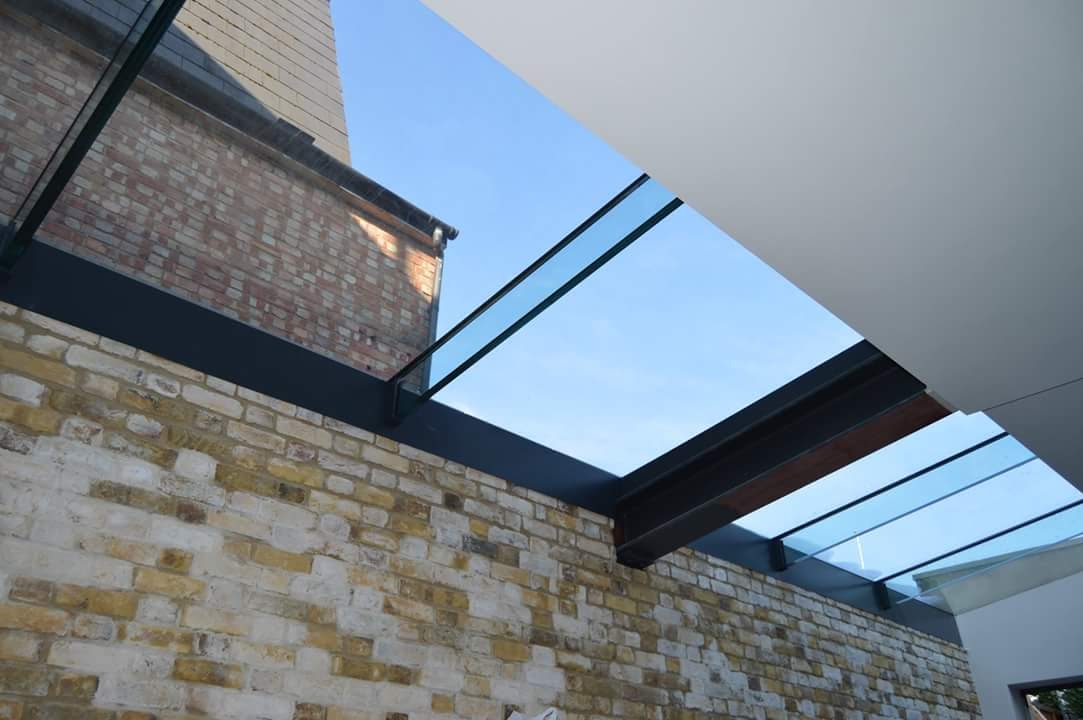
People ask which is stronger. It is the wrong question. Both toughened and laminated glass can be classified as safety glass, and choosing between them is almost always a question about what you want to happen at the moment it breaks.
What toughened glass is
Ordinary annealed glass is heated and then cooled quickly, which leaves the surfaces in compression. The result is much stronger than the same thickness of ordinary glass, and when it does finally break it goes all at once, into small blunt granules rather than shards. It also cannot be cut, drilled, notched or ground afterwards, so every hole and cut-out is made before the glass goes into the furnace. The product standard is BS EN 12150.
One honest footnote: very occasionally a toughened pane breaks with no impact at all, because of an inclusion left in the glass when it was made. It is uncommon, and it is one of the reasons toughened is not the default choice over your head.
What laminated glass is
Two or more panes bonded to a plastic interlayer. Break it and the pieces stay stuck to the interlayer, so the pane stays in its opening instead of leaving one. It is heavier for the same nominal thickness, it is better at cutting noise, and it can be cut, although the edge work is a different job to plain glass. The standards are BS EN ISO 12543 for the product and BS EN 14449 for its conformity.
1. Shower screen or bath screen
Toughened. It is the standard the enclosure product standard expects, it takes the hinge and clamp fittings, and granules on a wet floor are a far better outcome than shards. 8mm is the usual choice, 10mm where the screen is frameless.
2. Splashback behind a hob
Toughened, at 6mm, and this one is not a preference. It is the pane most likely to see real heat, and toughening is what lets it take it. Acrylic looks like a cheap alternative until it meets a hob, which is a reason to keep it well away from one.
3. Balustrade or barrier
Laminated, and usually toughened laminated, because a barrier has to keep containing people after it has been hit. Which laminated build, and how thick, comes out of a loading calculation for that balustrade. Take this one to a designer rather than to a thickness chart.
4. Rooflight, canopy or anything overhead
Laminated, so that a broken pane stays in the frame rather than arriving on the room below. This is the clearest case on the list, and it is decided entirely by what happens after the break.
5. A floor or a walk-on panel
Laminated, in a multi ply build with a sacrificial top layer that takes the wear and can fail without the panel failing. Structural, designed, and never a stock item.
6. Internal door, frameless or framed
Toughened, typically 10mm for a frameless door. A door carries patch fittings, hinges and often a lock, and all of those need holes and cut-outs which have to be machined before the toughening. Which is why the ironmongery has to be chosen before the glass is ordered, not after it arrives.
7. Shelf or table top
Toughened. Furniture glass sits outside the building regulations, but a shelf that fails over a floor is exactly the case toughening was invented for. Thickness follows the span rather than the taste: our calculators include a shelf sag check for exactly this.
8. Street level window, shopfront or anywhere security matters
Laminated. It can be broken, but it takes time and noise to get through, which is the point. If an insurance policy is involved, ask what the policy actually specifies and buy to that wording rather than to a general reputation for toughness.
9. Mirror
Usually neither: a mirror is float glass with a reflective backing. Where a mirror sits somewhere it could be walked into or fallen against, ask for a safety backed mirror, which carries a film on the back that holds the pieces together.
Two rules that catch most people out
First, the order of operations is fixed: cut, then edges, then holes and cut-outs, then heat. Everything you want in the panel has to be decided before the furnace, because after it the panel is finished, permanently.
Second, toughened glass carries slight optical distortion from the process. You see it in reflection, at an angle, on a large pane. It is normal, it is a consequence of how the glass is made safe, and it is not a defect.
If you are not yet sure whether the position needs safety glass at all, start with the seven places the law says you need it, or run the safety checker.