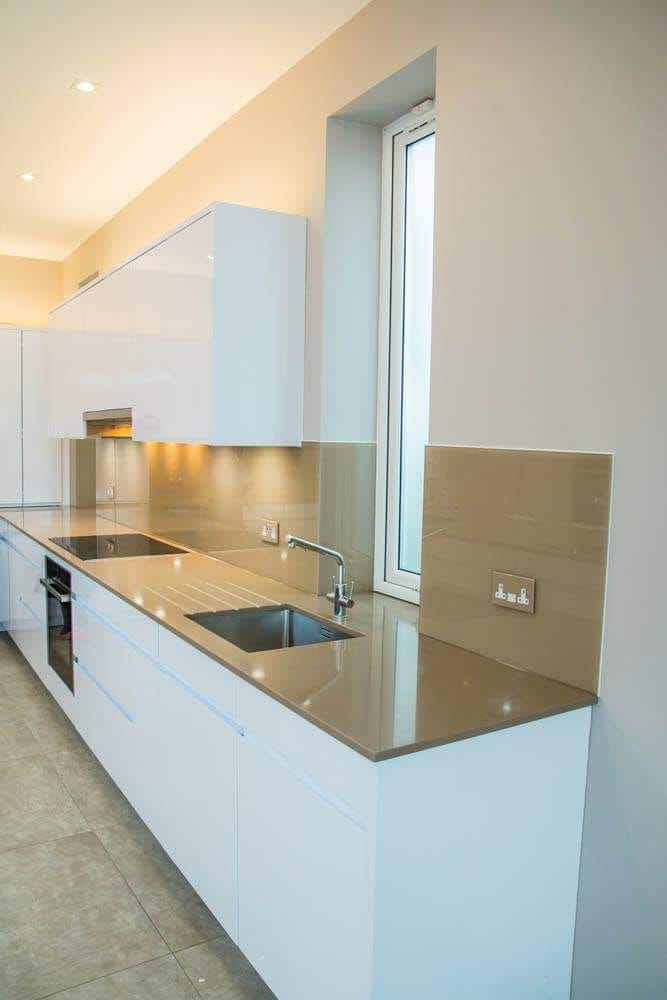
Every splashback quote is the same sum: the glass, what we do to the glass, and how it reaches you. That is why nobody can give you a price for a splashback without knowing the panel, and why any article that prints one is guessing.
We are not going to guess here. Our rates are set in the price book and shown live on the site, so a figure typed into a guide would be out of date the first time the rate moves. What this guide can do is tell you what the figure is made of, so you can read a quote, ours or anybody else, and see exactly where the money is.
1. The size of the panel
Glass is priced from its dimensions, so area is the first lever. Worth knowing: two small panels either side of a hob are not the same job as one continuous run, and a run that goes past a certain size stops being a one person lift, which changes how it is delivered and fitted.
2. The type of glass
Standard float glass carries a faint green cast that you will notice on a white wall or behind a pale colour. Low iron glass is noticeably clearer and costs more per square metre. Painted colour, mirror and tinted glass are all different prices again. If the colour of the wall behind matters to you, this is the choice to spend time on rather than the thickness.
3. Thickness and toughening
6mm toughened is the standard behind a hob. Toughening is a heat treatment rather than a coating, it is what makes the glass safe next to heat and impact, and it is not optional in that position. It also fixes the running order for everything else on this list, because nothing can be cut or drilled after it.
4. Cut-outs for sockets and switches
Every socket, switch and outlet is a machining operation, and each one has to be positioned before the panel is toughened. This is also where remakes come from: a socket measured from the wrong edge is not a small error, it is a new panel. Dimension every cut-out from the same two edges as the panel, and check them on the drawing before you approve it.
5. The edges
An edge that will be seen is polished. An edge that disappears behind a worktop, under a cooker hood or into a corner can be arrised, which is a lighter finish. Deciding which edges are actually visible is a real saving, and it is one most people never think to ask about.
6. Holes, notches and corners
A hole for a pipe, a notch around boxing, a radius corner where the panel meets a curve. Each one is time on a machine, and each one is another dimension that has to be right first time.
7. Whether the wall is square
A wall that is out of square cannot be described with a width and a height. It needs a template or a proper set of site measurements, and it produces a shaped panel rather than a rectangle. That is not an upsell, it is the only way a shaped opening gets a panel that touches on all sides.
8. How it reaches you, and who fits it
Collection from a branch costs nothing to move. Delivery is charged at the rate for your postcode. Templating and installation are separate service lines priced for the job in front of us, not a percentage bolted onto the glass, which means you can take the glass only and use your own fitter if you would rather.
One more thing before you compare two quotes
Check whether you are looking at the same VAT basis on both. Prices on this site can be shown with or without VAT, and trade accounts normally work ex VAT while a retail price is usually quoted including it. Two quotes that look far apart are quite often the same number seen from different sides of the VAT line.
See the real number for your panel
The honest answer to what a splashback costs is the price of yours, today. Our glass pricing tool reads the live price book, and the configurator prices the actual panel with its cut-outs and edges and draws it while you type. If you want to see the colour against your kitchen first, the splashback visualiser is free and needs nothing from you.
Before you order, it is worth reading the ten measuring mistakes, because the socket positions on a splashback are the most common thing in this whole list to get wrong.