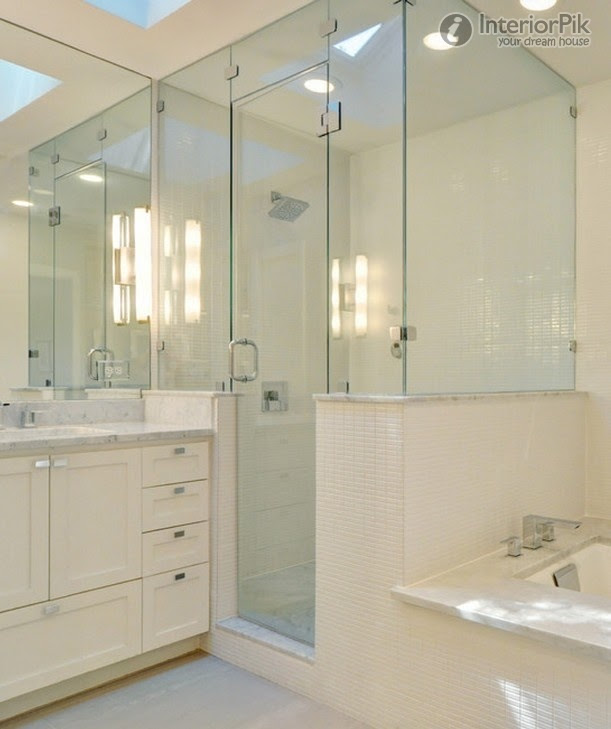
Made to measure glass is cut to the numbers you give us, to within a millimetre. That is the appeal of it, and it is also why a measuring mistake is expensive: a toughened panel cannot be trimmed afterwards, so a panel that is 4mm too wide is a new panel, not a quick shave.
None of what follows needs a laser or a survey. It needs a tape, five minutes, and the habit of not trusting the room.
1. Measuring once
Walls bow. Measure the width at the bottom, the middle and the top, and the height at both sides and in the centre. Write all of them down. The number that matters is the smallest, because the panel has to pass the tightest point on its way in.
2. Assuming the corners are square
Measure both diagonals of the opening, corner to corner. If they are not equal, the opening is not square, and a rectangle cut to the width and height will sit with a wedge shaped gap at one end. Tell us it is out of square rather than averaging the difference away.
3. Assuming the walls are plumb and flat
Hold a long spirit level or a straight edge against each wall, top to bottom. Old plaster leans and bows, and a wall that leans in over two metres will foul a panel that fitted perfectly on paper. A photograph with the level held against the wall tells us more than a paragraph describing it.
4. Measuring before the finish is on
Tiles, adhesive, panelling and a heavy coat of render all add thickness to a wall, and they all make the opening smaller. Measure the finished surfaces. If the tiling has not happened yet, say so and tell us what is going on the wall, so the size is worked out from the finish rather than from bare plaster.
5. Working in centimetres, or rounding to a neat number
We cut to within a millimetre, so give us millimetres. A width recorded as 89.5cm is ambiguous in a way that 895mm is not, and a number rounded to the nearest centimetre has already thrown away more tolerance than the fit can spare.
6. Forgetting that the glass needs somewhere to go
Glass cut to the exact size of the opening does not go in. A shower panel sits in a channel or against a seal, a splashback needs a gap it can be siliconed into, and every panel needs enough clearance to be lifted in at an angle. If you are ordering supply only, send the size you want the glass to be, not the size of the hole, and make sure whoever worked out the deduction knew which channel or seal is going to hold it.
7. Measuring to the wrong surface
Skirting, tile trim, a silicone bead, a tray upstand and a window reveal are all things a tape measures happily past. Decide what the glass is going to land on, then measure to that.
8. Forgetting what is in the way
Pipe boxing, a shower valve, a socket, a light switch, a radiator bracket, a window handle. Anything the glass has to clear or be cut around belongs on the drawing before the glass is cut, and cut-outs have to be positioned before toughening. Sketch them with two measurements each, taken from the same two datum edges you used for the panel itself.
9. Ignoring the floor
A wet room floor is laid to a fall, and an old floor is rarely level even when it looks it. A panel measured up from a sloping floor is the wrong height at one end. Measure from a level line rather than from the floor, and tell us the floor falls.
10. Assuming it can be adjusted on site
This is the one that costs money. Toughened glass cannot be cut, drilled or notched once it has been through the furnace. Every hole, notch and cut-out is made while the glass is still ordinary annealed glass, and the heat treatment is the last thing that happens to it. Nothing about the panel can change after that point, so resolve any doubt about a dimension before you order rather than hoping for a millimetre of forgiveness later.
The check before you press order
- Three widths, three heights and both diagonals, all in millimetres.
- The smallest of each, not the average.
- A note of anything out of square, out of plumb or bowed.
- Every cut-out dimensioned from the same two edges.
- A photograph of the opening with a tape in shot.
Our printable measuring pack is the workshop method on paper, with a record sheet that walks through the three points per dimension and the diagonals check. If the opening is awkward, or the glass is structural, have it measured properly instead: you can book a measure visit and let somebody else own the numbers.
Once you have your sizes, price the panel, and check the drawing that comes back against your own sketch before you approve it.